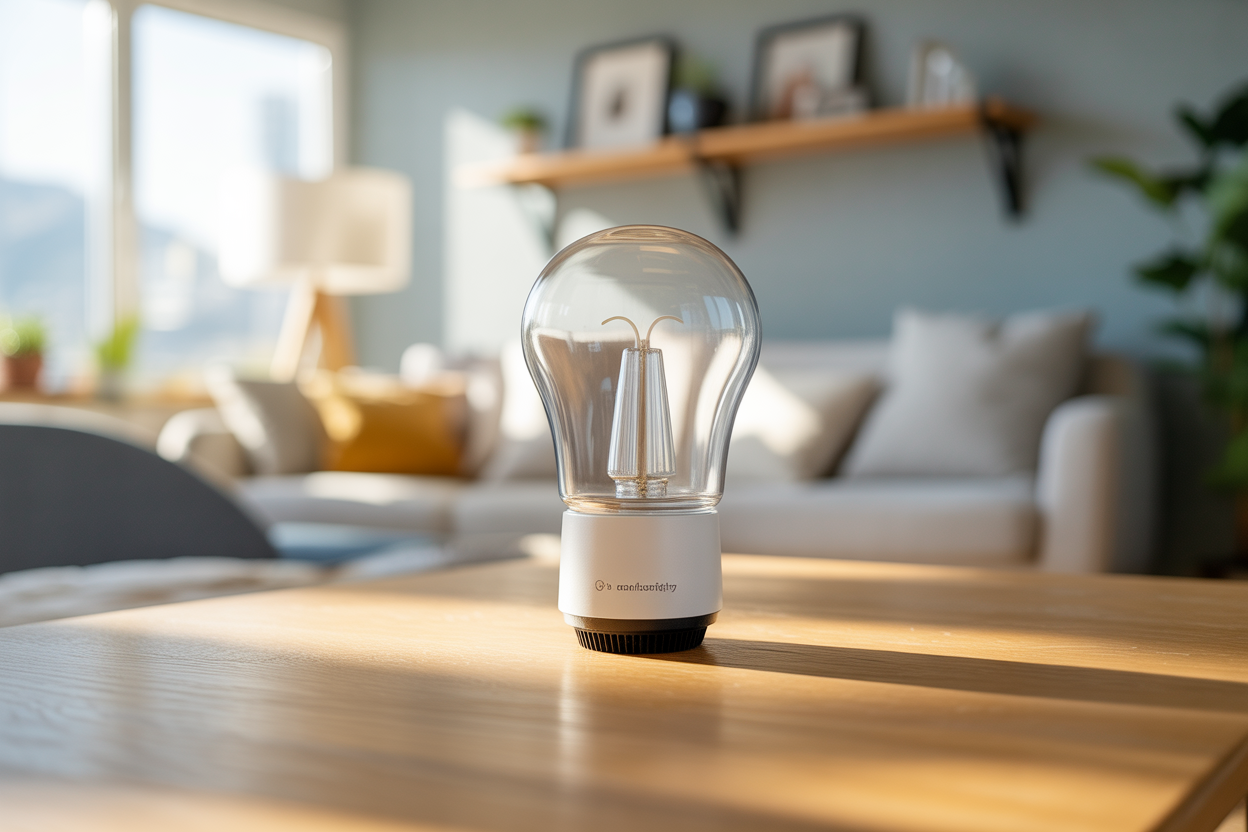

Smart lighting offers convenience, automation, and modern control, but many homeowners still ask the same question before upgrading: do smart lights use more electricity?
The concern usually comes from the fact that smart bulbs stay connected to Wi-Fi or a hub, even when the light appears to be off. This article explains how smart lights actually use power, how much electricity they consume in standby mode, and when professional electrical installation helps prevent unnecessary energy use.
How Smart Light Bulbs Work
Understanding how smart light bulbs work is essential to understanding their energy usage.
Smart bulbs are LED lights with built-in wireless communication chips. These chips allow the bulb to receive commands from mobile apps, smart hubs, or voice assistants. According to Security.org, smart bulbs rely on Wi-Fi, Zigbee, or Bluetooth connections to stay responsive, which is why they remain partially powered even when turned off through an app (Security.org, n.d.).
Unlike traditional bulbs that are either fully on or off at the switch, smart bulbs maintain a low-power standby state so they can instantly respond to commands. This constant connectivity is the main reason people question their energy efficiency.
Do Smart Lights Use More Electricity Than Standard LED Bulbs?
Yes, smart lights use slightly more electricity than standard LED bulbs, but the increase is very small.
Active energy use when lights are on
When illuminated, smart bulbs consume roughly the same wattage as non-smart LED bulbs with similar brightness. Most smart LEDs use between 8 and 12 watts, which is still far more efficient than incandescent bulbs.
The U.S. Department of Energy confirms that LED lighting uses at least 75% less energy than incandescent lighting to produce the same amount of light (U.S. Department of Energy, n.d.).
Standby energy use when lights are “off”
The key difference comes from standby power.
The International Energy Agency’s 4E Solid State Lighting Annex studied smart lamp standby behavior and found that connected lamps continue drawing power while idle so they can maintain network connectivity. However, the report shows that standby consumption is typically well under 1 watt per bulb (International Energy Agency, n.d.).
This means that even when smart lights are technically “off,” the electricity usage is minimal and usually translates to only a few dollars per year across an entire home.
Will Smart Lights Increase Your Electricity Bill?
In most real-world scenarios, smart lights do not meaningfully increase electricity bills.
While they do consume a small amount of standby power, smart lighting systems often reduce overall energy use through automation. Scheduling, motion-based activation, and dimming features help prevent lights from being left on unnecessarily.
The U.S. Department of Energy notes that lighting controls such as dimmers and occupancy sensors play a significant role in reducing lighting energy consumption, especially when combined with LED technology (U.S. Department of Energy, n.d.).
When Smart Lighting Can Use More Electricity
Smart lighting may increase energy use if it is poorly configured or improperly installed.
For example, lights left at full brightness all day, redundant fixtures added without load planning, or incompatible dimmers left in place can reduce efficiency. These issues are not caused by the bulbs themselves, but by installation and system design problems.
This is where professional electrical services make a difference.
Why Professional Electrical Installation Services Matter
Smart lighting interacts with wiring, switches, and electrical panels. Improper installation can prevent automation features from working correctly and may increase unnecessary energy draw.
Licensed electricians can:
- Remove incompatible dimmers
- Ensure circuits are not overloaded
- Optimize lighting placement
- Integrate smart controls properly
Using professional electrical installation services ensures smart lighting delivers its intended benefits without compromising efficiency or safety.
Are Smart Lights Worth It?
When installed correctly and used strategically, smart lights typically reduce wasted electricity, even though they draw minimal standby power. The combination of LED efficiency, automation, and scheduling usually results in lower total energy use than traditional lighting systems.
Smart lighting becomes most effective when paired with good configuration habits and expert electrical support.
Get Expert Help With Smart Lighting Installation
Smart lights do not significantly increase electricity usage on their own. However, installation quality and system setup determine whether they save or waste energy.
If you are considering smart lighting upgrades or want to ensure your system is installed efficiently and safely, get in touch with our team. Super Fast Electric provides professional electrical installation services that help smart lighting systems perform as intended. Go to our website if you would like to learn more about us.
References
International Energy Agency. (n.d.). Standby of smart lamps: First findings. IEA-4E SSL Annex.
https://www.iea-4e.org/ssl/our-work/standby-of-smart-lamps-first-report/
Security.org. (n.d.). How smart light bulbs work.
https://www.security.org/smart-home/smart-lights/
U.S. Department of Energy. (n.d.). LED lighting. Energy.gov.
https://www.energy.gov/energysaver/led-lighting