
How much does ceiling fan installation cost?
Ceiling fan installation by a licensed electrician typically costs $150 to $400 when existing wiring and a fan-rated electrical box are already in place. When new wiring needs to be run from the panel, the cost rises to $300 to $700 or more depending on the distance, the attic access, and whether the ceiling structure requires reinforcement. The fan itself is a separate purchase, and the total project cost depends on the fan, the wiring situation, and the room.
- Existing wiring in place. $150 to $400 for a licensed electrician to mount the bracket, connect the wiring, and test the fan, assuming a fan-rated box is already installed.
- New wiring required. $300 to $700+ when the electrician needs to run a new circuit or extend wiring from an existing junction box, including the fan-rated box installation.
- Why you need an electrician. Florida building code and the NEC require a licensed electrician for new circuits and permanent wiring connections, and a fan mounted on a standard light fixture box can fall.
What Ceiling Fan Installation Involves
Ceiling fan installation is not the same as hanging a light fixture. A ceiling fan weighs 15 to 50 pounds, spins at speed, and creates dynamic load that a standard electrical box cannot safely support. The National Electrical Code (NEC Article 314.27) requires that any outlet box used to support a ceiling-suspended fan be listed and identified for that purpose, meaning it must be a fan-rated box, not a standard light fixture box.
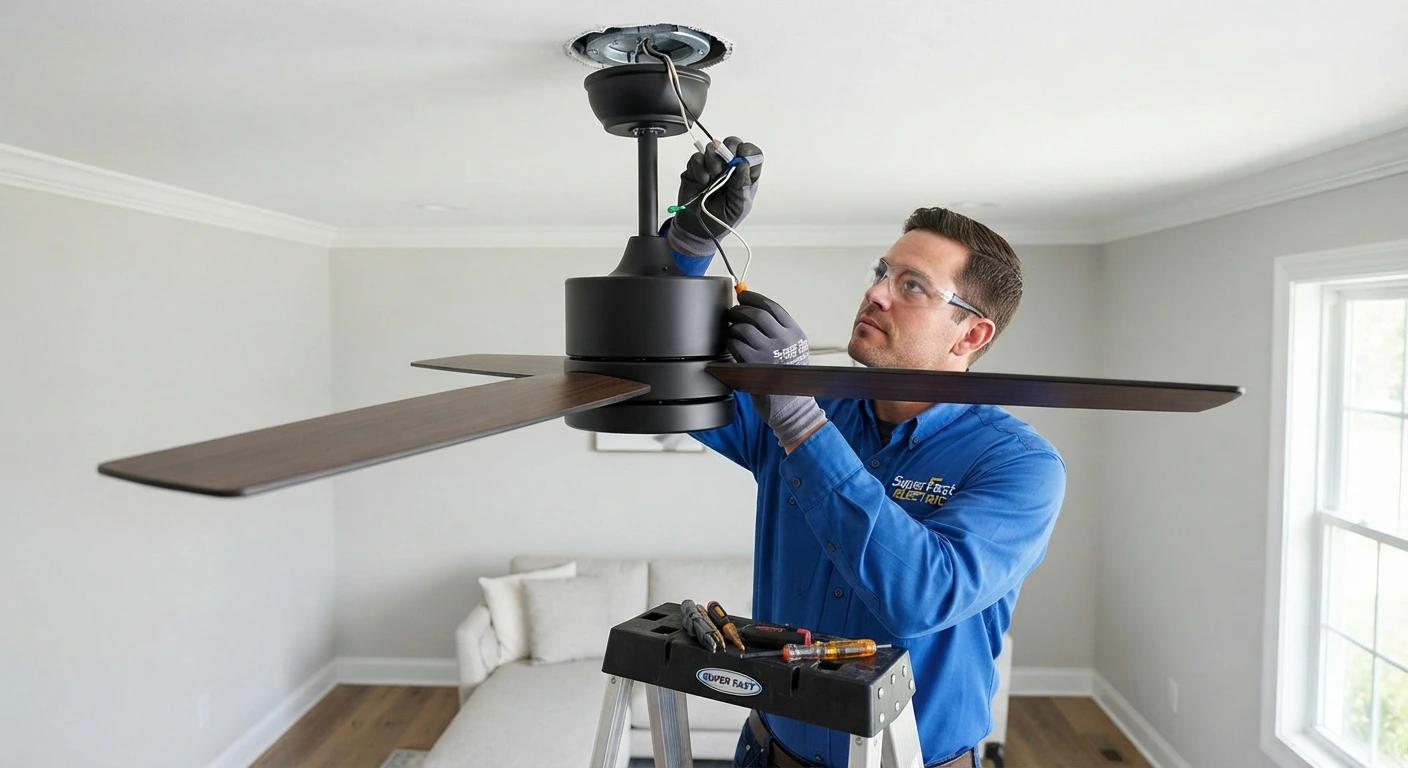
The installation itself involves mounting a fan-rated electrical box to the ceiling joist or a support brace between joists, connecting the supply wiring (typically a 14/2 or 14/3 cable on a 15-amp circuit), assembling the fan motor, blades, and light kit, and wiring the fan to the switch. If the fan has a separate light, a 14/3 cable with a dedicated switch leg allows independent control of the fan and the light from a dual wall switch.
The most common mistake we see homeowners make is installing a ceiling fan on the existing light fixture box without checking whether it is fan-rated. A standard plastic round box or a pancake box that is not listed for fan support can hold for months and then fail under the vibration and weight, which drops a 30-pound spinning appliance onto whatever is below it. This is why we always inspect the existing box before starting a fan installation, and replace it with a fan-rated box if it does not meet code.
Ceiling Fan Installation Cost Breakdown
| Installation type | Typical cost range | What is included | Common scenario |
|---|---|---|---|
| Swap (fan for fan) | $100 to $200 | Remove old fan, mount new fan on existing box and wiring | Replacing an outdated fan |
| Light to fan (existing wiring) | $150 to $400 | Install fan-rated box, connect to existing circuit, mount fan | Adding a fan where a light fixture was |
| New wiring required | $300 to $700+ | Run new circuit or extend wiring, install box, mount fan | No existing ceiling outlet in the room |
| Fan with smart controls | $200 to $500 | Standard install plus smart switch wiring and setup | Adding a WiFi-controlled fan or smart wall switch |
| Vaulted or high ceiling | $250 to $600 | Extended downrod, scaffolding or lift, standard wiring | Ceilings above 10 feet |
These ranges cover labor only and assume the homeowner has already purchased the fan. The fan itself typically runs $50 to $500 depending on the brand, blade span, and features. For homes that need a panel upgrade to support a new circuit, that is a separate project with its own cost. In Central Florida, most ceiling fan installations fall in the $150 to $400 range because the majority of homes already have wiring in the ceiling from an existing light fixture.
Do you need an electrician to install a ceiling fan?
You need a licensed electrician whenever the installation requires new wiring, a new circuit, or a change to the electrical box. In Florida, any work that involves running new conductors, connecting to the panel, or modifying permanent wiring requires a licensed electrical contractor under Florida Statute 489.505. Replacing a fan on an existing fan-rated box with matching wiring is technically within a homeowner’s ability, but the liability and safety risk make professional installation the standard recommendation.
The situations that always require an electrician include installing a fan where no ceiling outlet exists, running a new switch leg for separate fan and light control, adding a fan on a circuit that is already near capacity, installing on a vaulted or cathedral ceiling where the mounting hardware differs from a standard flat ceiling, and any installation in a bathroom where GFCI protection and damp-rated fan requirements apply.
One question we get constantly from Orlando homeowners is whether they can install a ceiling fan themselves if the wiring is already there. The honest answer is that the wiring is only half the question. The other half is the box, and most homeowners cannot tell from looking at it whether the box is fan-rated or just a standard fixture box. An electrician checks the box, verifies the circuit capacity, confirms the wiring gauge, and makes sure the installation meets NEC and Florida code. For more on what a professional inspection covers, see our home electrical safety inspection guide.
A ceiling fan mounted on the wrong box or wired to an overloaded circuit is not just a code violation. It is a safety hazard. Super Fast Electric installs ceiling fans across Central Florida with licensed electricians, fan-rated box verification, and code-compliant wiring on every job. Same-day and next-day appointments available.
Common Ceiling Fan Installation Mistakes
The calls we get to fix ceiling fan problems almost always trace back to one of these five installation mistakes, whether the fan was installed by the homeowner or by an unlicensed handyman.
- Mounting on a non-fan-rated box. A standard light fixture box is rated for 50 pounds of static weight. A ceiling fan creates dynamic rotational force that exceeds that rating. NEC Article 314.27(C) requires a fan-rated box listed specifically for ceiling fan support.
- Using 14/2 wire when 14/3 is needed. If the homeowner wants separate wall switches for the fan and the light, a three-conductor cable with a dedicated switch leg is required. Installing 14/2 and then discovering the fan and light cannot be controlled independently means pulling new wire after the ceiling is closed.
- Overloading the circuit. A ceiling fan draws 60 to 120 watts on its own, plus whatever the light kit adds. On a 15-amp circuit that already serves several outlets and fixtures, adding a fan can push the load close to the breaker limit, causing nuisance tripping.
- Wrong downrod length for the ceiling height. The NEC and most fan manufacturers recommend a minimum of 7 feet of clearance between the floor and the bottom of the fan blades. A fan installed too close to the ceiling on a standard mount when it should have a longer downrod runs less efficiently and creates more noise.
- Skipping the balancing step. An unbalanced fan wobbles, which creates noise, loosens the mounting hardware over time, and can eventually cause the canopy to separate from the ceiling. Balancing takes five minutes with the kit included in the fan box, and skipping it turns a clean install into a callback.
Ceiling Fans and Smart Home Wiring
Smart ceiling fans and smart wall switches are one of the fastest-growing installation requests we handle in Central Florida. A WiFi-enabled fan or a smart switch like the Lutron Caseta fan control requires a neutral wire at the switch box, which older Florida homes built before the mid-1980s often do not have. If the switch box has only a hot wire and a switch leg with no neutral, the smart switch will not work without running a new cable. For more on smart home wiring requirements, see our guide to smart home electrical upgrades.
The other smart fan consideration is compatibility. Not every smart switch works with every fan motor. DC motor fans, which are increasingly common in high-efficiency models, require a switch rated for DC motors. Putting a standard dimmer on a fan motor that is not designed for it can damage the motor, create a fire risk, and void the warranty. We verify motor type and switch compatibility before every smart fan installation.
A ceiling fan on a dimmer switch is the single most common electrical mistake we see in older Central Florida homes. Standard dimmers are designed for incandescent light loads, not motor loads. Running a fan motor through a standard dimmer causes overheating, buzzing, and premature motor failure. If you want variable speed control, the solution is a fan speed control switch rated for motor loads, not a light dimmer. For a broader look at all the electrical services we offer across residential and commercial properties, our services page covers the full scope.
Frequently Asked Questions
Can I install a ceiling fan where there is no existing wiring?
Yes, but it requires running new wiring from a power source to the ceiling location, installing a fan-rated electrical box, and adding a wall switch. This is new electrical work that requires a licensed electrician in Florida. The cost is typically $300 to $700 or more depending on the wiring distance and attic accessibility.
What is a fan-rated electrical box?
A fan-rated electrical box is a junction box specifically listed and tested to support the weight and dynamic load of a ceiling fan. NEC Article 314.27(C) requires it for any ceiling-suspended fan. Standard light fixture boxes are not rated for the rotational force a fan creates and can fail over time, dropping the fan.
How long does ceiling fan installation take?
A straightforward swap of an existing fan or a new fan on existing wiring typically takes 45 minutes to 90 minutes. An installation that requires running new wiring, installing a fan-rated box, or adding a new switch takes 2 to 4 hours depending on attic access, ceiling structure, and the distance from the power source.
Can I put a ceiling fan on a dimmer switch?
No, unless the dimmer is specifically rated for fan motor loads. Standard light dimmers cause fan motors to overheat, buzz, and fail prematurely. For variable speed control, install a fan speed control switch designed for motor loads, or choose a fan with a built-in remote that handles speed control at the motor rather than the wall.
Do I need a permit for ceiling fan installation in Florida?
Replacing a fan or light fixture on existing wiring generally does not require a permit. Installing new wiring, adding a new circuit, or running cable to a location that did not previously have an outlet typically does require an electrical permit in Orange, Seminole, and Osceola counties. Your electrician handles the permit when one is needed.
What size ceiling fan do I need for my room?
For rooms up to 75 square feet, a 29 to 36 inch fan. For 76 to 144 square feet, a 36 to 42 inch fan. For 144 to 225 square feet, a 44 to 50 inch fan. For 225 to 400 square feet, a 50 to 54 inch fan. For rooms larger than 400 square feet, a 60 inch fan or two fans. Measure the room before purchasing.
Next Steps
Already know what you need? Contact Super Fast Electric for a same-day or next-day ceiling fan installation quote in Central Florida.
Not sure if your home’s wiring can handle a new fan? Schedule a home electrical safety inspection and we will check your panel capacity, box rating, and circuit load before the fan goes up.
Thinking about adding smart controls to your new fan? Read our smart home electrical upgrades guide for the wiring requirements.
A ceiling fan is one of the best comfort and energy upgrades a Central Florida homeowner can make, but only when it is mounted on the right box, wired to the right circuit, and installed to code. Super Fast Electric handles ceiling fan installation across Orlando, Kissimmee, and the surrounding areas with licensed electricians, same-day scheduling, and no surprise charges.