
What Does EV Charger Installation Involve?
EV charger installation is the process of adding a dedicated 240-volt circuit and charging station to your home so your electric vehicle charges overnight without relying on public stations. As of 2026, more than 90 percent of EV charging happens at home once a Level 2 charger is installed, and the job typically requires a licensed electrician, a permit, and a load calculation to confirm your electrical panel can support the additional draw.
What it costs: Most Central Florida Level 2 installations run between $800 and $2,500 depending on distance from the panel, whether a panel upgrade is needed, and the amperage of the charger.
What your panel needs: A 200-amp panel in good condition can usually support a 40-amp EV circuit without an upgrade, but a load calculation is the only way to confirm it.
Why permits matter: An unpermitted EV charger installation can create problems with homeowner’s insurance, resale disclosures, and future electrical inspections.
Level 1 vs. Level 2 vs. DC Fast
Not every charger type makes sense for a home. Understanding the differences prevents overspending on equipment you do not need and avoids installing a charger that is too slow to keep up with your driving.
| Level 1 | Level 2 | DC Fast (Level 3) | |
|---|---|---|---|
| Voltage | 120V (standard outlet) | 240V (dedicated circuit) | 480V+ |
| Miles added per hour | 3 to 5 | 25 to 40 | 100 to 200+ |
| Typical amperage | 12A | 32A to 48A | 100A+ |
| Residential use | Backup only | Standard for homes | Commercial only |
| Installation needed | None (plugs into outlet) | Dedicated circuit + permit | Major electrical infrastructure |
For residential use, Level 2 is the standard. It adds 25 to 40 miles of range per hour of charging, which means an overnight charge covers more driving than most Central Florida commuters do in a day. Level 1 plugs into a standard household outlet and requires no installation, but at 3 to 5 miles per hour, it takes 24 to 48 hours to fully charge a depleted battery. DC fast charging is designed for commercial locations and requires electrical infrastructure that residential properties do not support.
As of 2026, the North American Charging Standard (NACS), originally Tesla’s connector design, has been adopted by most major manufacturers. Adapters are widely available for vehicles that still use the J1772 plug, and most Level 2 charging stations can be configured to work with either connector type.
How Much Does EV Charger Installation Cost?
The average cost of a Level 2 home charger installation in Florida is approximately $1,700 based on 2026 Qmerit project data. Most homeowners pay between $800 and $2,500 for the complete job, including the circuit, wiring, breaker, labor, and permit. The charger unit itself typically costs $300 to $700 on top of the installation.
Three factors drive almost every cost variation we see on EV charger installations across Central Florida homes:
Distance from the panel. A charger mounted five feet from the electrical panel costs significantly less in wire and labor than one mounted 50 or 70 feet away in a detached garage. Outdoor or detached-garage installs may require conduit runs or trenching, which adds $500 to $1,500 or more.
Panel capacity. If your panel cannot support the additional load, a panel upgrade adds $1,500 to $3,000 to the project. A load calculation determines whether an upgrade is necessary before any work begins.
Amperage of the charger. A 40-amp charger on a 50-amp breaker is the most common residential setup. Stepping up to a 48-amp charger on a 60-amp breaker increases wire gauge requirements and breaker cost, but it does not charge faster unless your vehicle’s onboard charger can actually accept the higher amperage. Paying for a 60-amp circuit when your vehicle only accepts 32 amps does not charge the car faster, it just increases the installation cost.
The federal Section 30C tax credit for home charger installations remains available through June 30, 2026, covering up to 30 percent of the cost (up to $1,000) for properties in eligible census tracts. Duke Energy Florida also offers a $7.50 monthly off-peak charging credit for residential electrician services customers who charge during designated low-demand hours.
What the Installation Process Looks Like
A properly permitted EV charger installation follows a specific sequence. Skipping steps, particularly the load calculation and the permit, creates problems that surface later during home sales, insurance claims, or panel inspections.
1. Schedule a site evaluation. The electrician inspects your panel, measures the distance to the charging location, and identifies the circuit route. This is when photos of the panel, the path, and the parking spot save time.
2. Run a load calculation. The electrician calculates the total electrical demand on your panel to confirm whether it can support the new circuit or whether an upgrade is needed.
3. Pull the permit. The electrician files permit paperwork with your local building department. In Orange, Seminole, and Osceola counties, permit requirements vary slightly by jurisdiction.
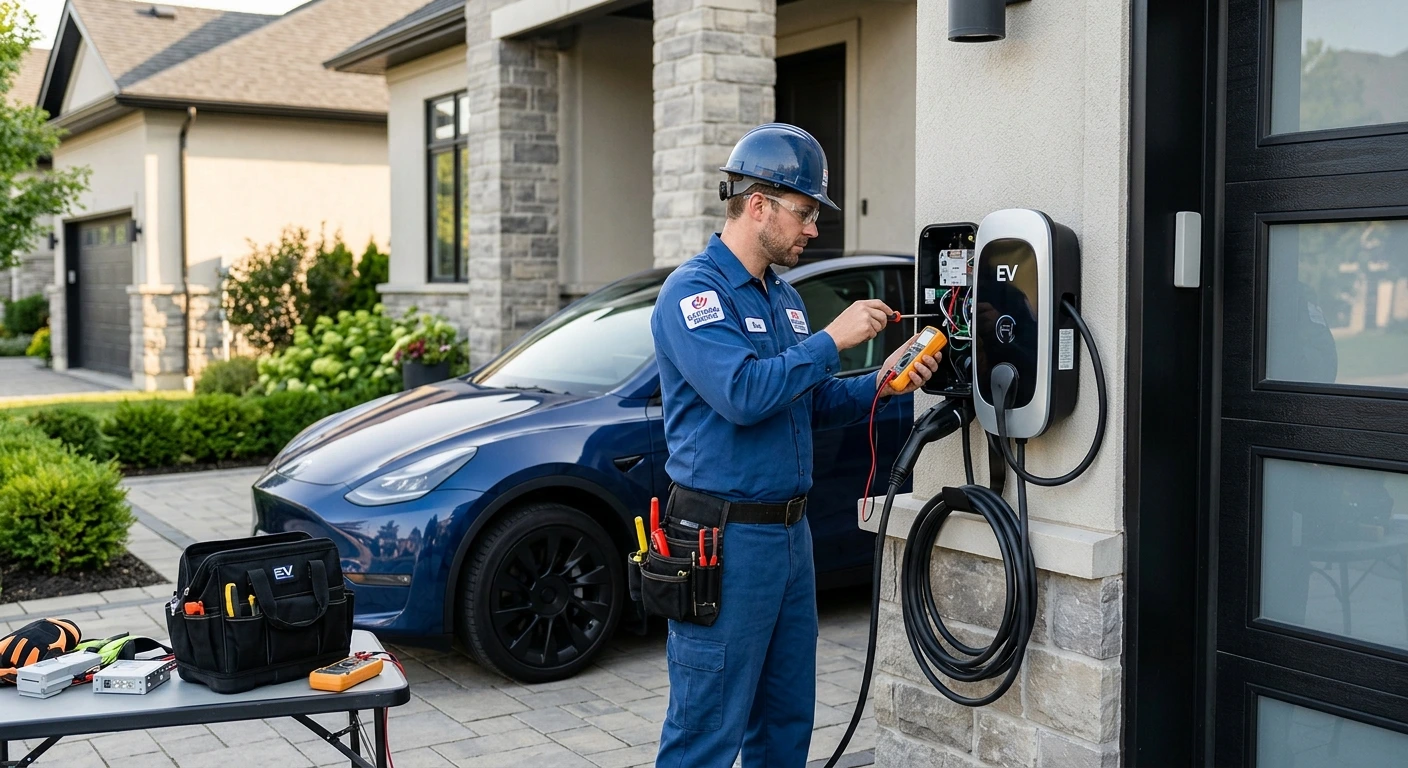
4. Install the circuit and charger. The electrician runs the wiring from the panel to the charger location, installs the breaker, and mounts the charging station. Hardwired installations connect the charger directly to the circuit, while plug-in installations use a NEMA 14-50 outlet.
5. Inspection and activation. A local inspector verifies the work meets code. Once it passes, the charger is energized and ready to use.
We handle permitting in-house and coordinate directly with Duke Energy and local building departments across all 20 Central Florida cities we serve. That coordination matters because permit requirements, inspection scheduling, and utility notification steps differ between jurisdictions, and missing one of them delays the project.
Whether you need a simple Level 2 charger on an existing 200-amp panel or a full panel upgrade to support a high-amperage circuit, the process starts with a site evaluation and load calculation. Super Fast Electric handles permitting, utility coordination, and installation across 20 Central Florida cities.
Does Your Electrical Panel Need an Upgrade?
Not every EV charger installation requires a panel upgrade, but every installation requires a load calculation to find out. A 200-amp panel in good condition can usually support a 40-amp EV charger circuit if the existing loads leave enough headroom. Older 100-amp or 150-amp panels, and panels that already support high-draw appliances like electric water heaters, HVAC systems, and pool pumps, are more likely to need an upgrade.
The calculation works by adding up every circuit breaker’s rated load and comparing the total to the panel’s capacity. If the EV charger pushes the total past what the panel can safely handle, the options are a full panel upgrade or a load management device that throttles the charger when other high-draw appliances are running.
One pattern we see regularly in Central Florida homes built in the 1990s and early 2000s is a 200-amp panel that appears to have capacity on paper but has outdated breakers, corrosion from humidity, or wiring that does not meet current NEC standards. In those cases, the EV charger project becomes the right time to address warning signs your electrical panel needs attention before adding a new high-demand circuit on top of an aging system.
If your home still has a Federal Pacific or Zinsco panel, plan for a full replacement regardless of the EV charger. These panels have documented failure modes where breakers do not trip under overload conditions, and no licensed electrician should add a new 40-amp or 60-amp circuit to one.
Permits, Inspections, and Code
A permitted EV charger installation creates a record that the work met code at the time it was installed. That record matters for homeowner’s insurance, resale disclosures, and any future electrical work on the property. An unpermitted installation, even a clean one, can complicate all three.
In Central Florida, permit requirements for EV charger circuits vary by county and municipality. Orange County, Seminole County, and Osceola County each have their own building department, and cities within those counties may have additional requirements. The electrician handling the project should pull the permit, schedule the inspection, and confirm that the work passes before handing the charger over to the homeowner.
Current National Electrical Code requires that NEMA 14-50 outlets installed for EV charging be protected by a GFCI breaker, which costs $200 to $400 more than a standard double-pole breaker. Hardwired EV chargers have GFCI protection built into the unit itself, which means you can use a standard breaker and avoid that additional cost. This is one reason hardwired installations have become the preferred approach for permanent home chargers in 2026.
Florida Incentives and Duke Energy Credits
Florida does not offer a statewide EV charger rebate or state income tax credit in 2026. The financial help for home installations comes from the federal level and from your utility provider.
The federal Section 30C Alternative Fuel Vehicle Refueling Property Credit covers up to 30 percent of the cost of purchasing and installing a home EV charger, with a maximum credit of $1,000 for residential installations. This credit is available through June 30, 2026, and applies to properties in eligible census tracts. Check eligibility before assuming the credit applies to your address.
Duke Energy Florida offers an off-peak charging credit of $7.50 per month for residential customers who avoid charging between the designated on-peak hours. The program is now permanent with no enrollment cap. OUC customers in the Orlando area may have access to separate charger programs. Check your specific utility provider’s EV page for current 2026 offers, since programs change by year and sometimes by quarter.
Between the federal credit and utility savings, many homeowners offset a meaningful portion of the installation cost within the first one to two years. A surge protector installed at the panel is a separate but worthwhile addition, since power restoration surges after Florida storms can damage both charger electronics and vehicle charging systems.
Common EV Charger Installation Mistakes
Most installation problems are preventable if you know what to ask before the work starts.
Oversizing the circuit for no reason. Installing a 60-amp circuit when your vehicle only accepts 32 amps of AC charging does not make the car charge faster. Match the circuit to the vehicle’s onboard charger capacity and save the cost difference.
Skipping the permit. An unpermitted installation can void insurance coverage, create resale complications, and leave you with no recourse if the work was done incorrectly.
Choosing location by convenience instead of function. Mounting the charger right next to the panel saves money, but if it means the cable cannot reach the vehicle’s charge port without stretching across a walkway, the installation creates a daily tripping hazard.
Ignoring panel condition. Adding a 40-amp circuit to a panel with corroded breakers, evidence of overheating, or outdated wiring is building on a weak foundation. Address the panel first.
Not confirming utility coordination. Some jurisdictions require the utility to be notified before a high-demand circuit is added. Missing this step can delay inspections and final activation.
Frequently Asked Questions
How long does a home EV charger installation take?
Most Level 2 installations take three to six hours once the permit is approved. If a panel upgrade is needed, the project may require a separate visit. Permit approval timelines vary by jurisdiction in Central Florida, typically ranging from a few days to two weeks.
Can I install an EV charger myself?
In Florida, electrical work that involves adding a new circuit to the panel requires a licensed electrical contractor. A homeowner can physically mount the charger unit, but the circuit, breaker, and wiring must be installed by a licensed professional and inspected by the local building department.
Do I need a 200-amp panel for an EV charger?
Not necessarily. A 200-amp panel is the most common residential panel and usually supports a Level 2 charger. However, a load calculation is the only way to confirm your specific panel has enough capacity. Homes with 100-amp or 150-amp panels are more likely to need an upgrade.
What is the difference between hardwired and plug-in EV chargers?
A hardwired charger is connected directly to the circuit with no outlet. A plug-in charger uses a NEMA 14-50 outlet. Hardwired installations avoid the additional cost of a GFCI breaker required for EV outlets under current NEC rules, which often makes hardwiring the more cost-effective permanent option.
Does an EV charger increase my electric bill?
Yes, but typically far less than the gasoline it replaces. At Florida’s average residential rate of approximately $0.15 per kilowatt-hour, charging an EV costs roughly $40 to $60 per month for average driving. Duke Energy’s off-peak credit reduces that further if you charge during low-demand hours.
Will an EV charger increase my home value?
A permitted, professionally installed Level 2 charger is increasingly viewed as a home upgrade by buyers, similar to a generator transfer switch or smart home wiring. The key is that the installation is permitted and inspectable, which is why professional installation matters for resale value.
Next Steps
Start with a site evaluation to determine your panel capacity, the best charger location, and whether any upgrades are needed before installation.
If your home’s panel is older than 25 years or shows signs of wear, schedule an electrical safety inspection alongside the EV charger consultation to address both at once.
Super Fast Electric serves 20 Central Florida cities with licensed Master Electricians, handles permitting and Duke Energy coordination in-house, and backs every installation with warranties up to 10 years.
Stop guessing whether your panel can handle a charger. Super Fast Electric runs the load calculation, pulls the permit, coordinates with Duke Energy, and installs the charger across 20 Central Florida cities. Over 20,000 service calls completed since 2017, 800+ five-star Google reviews, and a 100% satisfaction guarantee on every job.